Mastering Word Problems with Bar Model Strategies: A Visual Approach to Math Success
Solving word problems can be one of the most challenging aspects of math for students, especially in the elementary school. Not only do word problems require understanding of math concepts but also reading comprehension, reasoning, and strategy. The best way to make word problems more approachable, and even enjoyable, is the bar model strategy.
Whether you’re a classroom teacher or a homeschool mom, using bar models gives children concrete, visual representations to understand what a problem is asking and how to solve it. In this post, we’ll explore everything you need to know about bar model strategies: what they are, why they work, how to use them, and examples you can start using today.
What is a Bar Model?
Bar models (also known as strip diagrams or tape diagrams) are visual representations of math relationships using rectangular bars. Instead of jumping into symbolic math (like equations), students first draw simple, labeled bars to show how quantities relate to each other.
Bar models are especially useful for:
- Addition and subtraction word problems
- Multiplication and division word problems
- Multi-step and comparison word problems
- Fractions, ratios, and even algebra concepts later on
By representing numbers with bars, students develop number sense, understand relationships, and can see how part and whole connect – all before touching a pencil to do formal computation.
Why Use Bar Models for Word Problems?
Here’s why the bar model method is so effective:
- They make abstract problems concrete: Children see relationships instead of just numbers.
- They reduce confusion: Visuals help clarify what’s being asked, especially in multi-step problems.
- They build conceptual understanding: Rather than memorizing keywords (like “more than” or “total”), students understand what’s actually happening.
- They support all learners: Visual strategies benefit struggling learners and challenge advanced thinkers.
- They promote problem solving confidence: Students feel empowered when they can picture the problem before solving it.
Types of Bar Models
There are two main types of bar models:
1. Part-Whole Models
Used for problems involving addition or subtraction.
- Structure: One large bar (whole) is divided into smaller bars (parts).
- Example:
Sarah has 7 red apples and 5 green apples. How many apples does she have in total?

- Students can visually see the parts and find the whole by adding.
2. Comparison Models
Used for problems that compare two quantities (often involving subtraction or multiplication).
- Structure: Two bars stacked or side by side for comparison.
- Example:
Tom has 12 marbles. Jane has 7 marbles. How many more marbles does Tom have than Jane?

These models help illustrate the difference between the two amounts and support subtraction strategies.
Use the Following Steps to Solve Word Problems Using Bar Models
Step 1: Read the problem carefully
Ask: What is happening in the story?
Step 2: Underline or identify key information
Look for quantities and relationships.
Step 3: Decide what type of model to use
Is it part-whole or comparison?
Step 4: Draw the bar model
Use boxes or bars to show the parts, wholes, or comparison.
Step 5: Label the bars with known and unknown information
Use numbers for known values and question marks for unknown quantities.
Step 6: Use the model to write an equation (if needed)
Solve using addition, subtraction, multiplication, or division.
Step 7: Answer the question
Write your answer in a complete sentence.
Bar Model Word Problem Examples by Grade Level
Let’s look at bar model examples across different skills and grade levels.
1st Grade Math: Addition (Part-Whole)
Problem: Emma has 3 red balloons. Her mom gives her 4 more blue balloons. How many balloons does Emma have now?
Bar Model:

Equation: 3 + 4 = 7
Answer: Emma has 7 balloons.
2nd Grade Math: Subtraction (Part-Whole)
Problem: There are 14 cookies. 6 were eaten. How many are left?
Bar Model:

Equation: 14 – 6 = 8
Answer: There are 8 cookies left.
3rd Grade Math: Multiplication (Repeated Addition) and Division Problems
Problem: There are 4 bags of oranges. Each bag has 6 oranges. How many oranges are there in total?
Bar Model:

Equation: 6 × 4 = 24
Answer: There are 24 oranges.
Problem: Sam has 18 toy cars. He wants to put 6 cars on each shelf. How many shelves does Sam need?
Bar Model:

Equation: 18 ÷ 6 = 3
Answer: Sam will need 3 shelves.
4th Grade Math: Two-Step Problems
Problem: Liam bought 3 packs of pencils. Each pack has 5 pencils. Then he gave 4 pencils to his friend. How many pencils does he have left?
Step 1: Bar model for multiplication:

Equation: 3 x 5 = 15
Step 2: Bar model for subtraction:

Equation: 15 – 4 = 11
Answer: Liam has 11 pencils left.
5th Grade Math: Fractions and Ratios
Problem: There are 24 students. ⅓ of them are girls. How many girls are there?
Bar Model:

Answer: There are 8 girls.
Teaching Tips for Using Bar Models
1. Start Simple
Begin with part-whole models and concrete problems. Use real-life stories and manipulatives first.
2. Model the Process
Solve problems together with your child or class and draw the bar model step by step. Talk aloud as you model your thinking.
3. Use Consistent Visual Bar Models
Keep bar length and proportions accurate. It doesn’t have to be perfect, but consistency helps build understanding.
4. Color-Code the Parts
Use different colors for different parts or quantities to help children distinguish components visually.
5. Use Real Life Scenarios
A great way to make your students interested in math problems is by creating word problems based off of their own interests…use their names in the problems, favorite sports, and activities.
6. Gradually Increase Complexity
Once students master basic bar models, introduce two-step problems, comparisons, and fractional relationships.
7. Incorporate Writing
Have students explain their thinking: “I drew two bars to show the total and the part we know…”
Common Mistakes to Watch For
- Confusing which number is the whole vs the part
- Using incorrect bar lengths (too similar or reversed)
- Not labeling the bars or leaving out the question mark for the missing number
- Jumping to computation before drawing
Address these with guided practice and discussion. Have them answer questions like, “What does each bar represent?” or “Can you show me what we’re trying to find?”
Resources for Bar Model Practice
Looking to dig deeper or give your students extra practice?
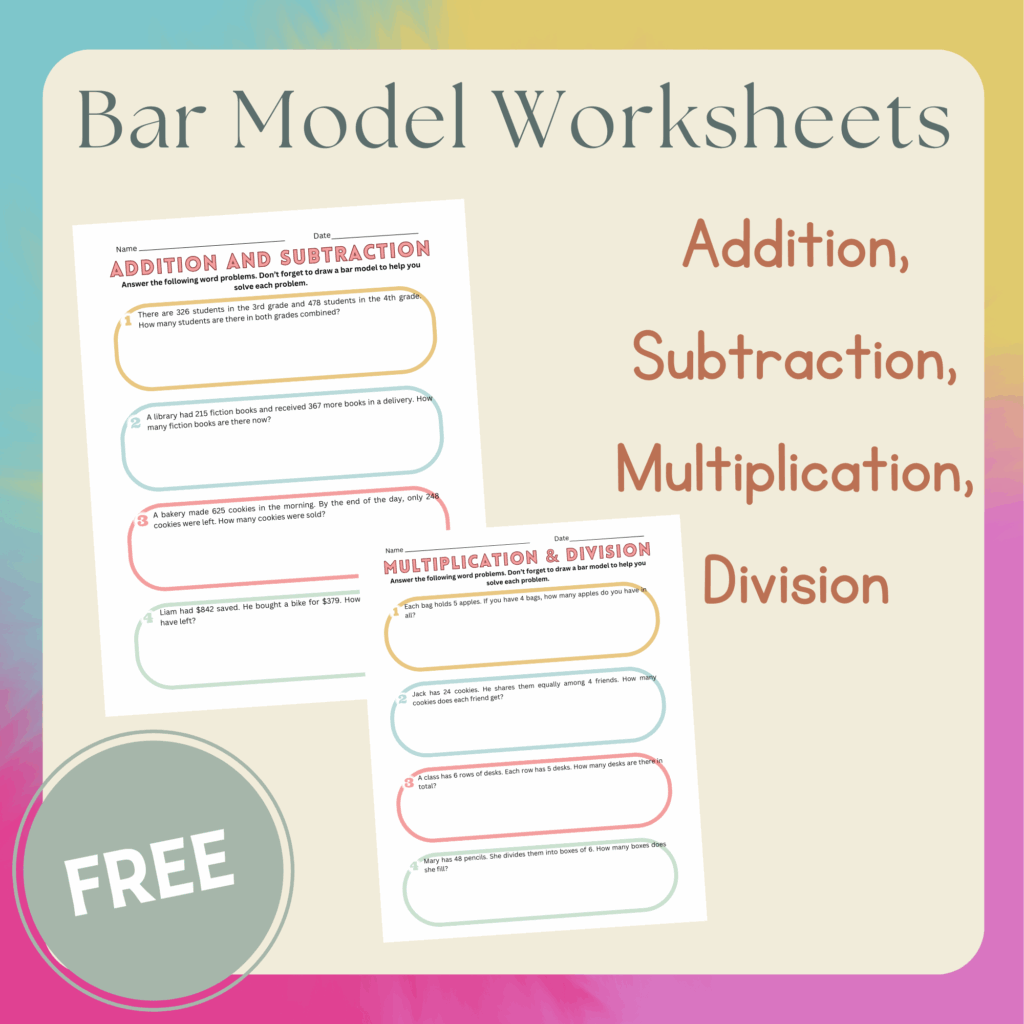
Free Worksheets Bar Model:
We have created a FREE download for you to use with your elementary school students.
This resource includes worksheets with bar model math problems for:
- 1st graders just starting to learn basic operations like addition
- 2nd graders working on subtraction and 3-digit numbers
- 3rd graders learning multiplication and division problems
- 4th graders sharpening all these skills with two-step problems.
Bar models are a game-changer for solving word problems. They bridge the gap between words and numbers, giving students the tools they need to understand, visualize, and solve with confidence. With the help of bar problems, word problems will soon become independent work for your students this school year. Whether your child struggles with math or is ready for the next level of problem-solving, bar models offer a clear, visual strategy that can grow with them from kindergarten all the way through middle school.
By integrating bar model strategies into your math instruction, you’re not just helping your students solve word problems—you’re helping them understand math deeply.
Check out this blog post for more free math resources!